
Don’t hate the players. Hate the game.
What’s a campaign cycle without good old-fashioned class warfare? In a recent move to alienate the art museum crowd and tank their economy, Washington became the first state to enact a millionaire’s tax. Now Maine and New York City are considering the same. California has been working on taxing the assets of the very rich and Illinois is looking into a 3% surcharge for the crime of earning over $1M a year.
There’s a much easier solution. Stop spending.
Stop spending and you won’t have to tax more.
Except these taxes aren’t about generating revenue for the state. They’re about punishing the wealthy for being wealthy. It’s politically expedient to blame the rich, tax them, and claim they’re not paying their “fair share.”
It’s convenient. That’s why politicians do it. It’s not economically sound. It’s not even true in most cases. It’s just a convenient way to shift the spotlight from the real problem: government overspending.
At happy hour recently with some of my favorite people in the world, both moms, both entrepreneurs, both writers, one of them asked me, “What about the billionaires?”
Is it fair, she wanted to know, that people like Elon Musk and Jeff Bezos have amassed so much wealth on the backs of workers they underpay, lay off, and otherwise take for granted? Shouldn’t billionaires pay their fair share?
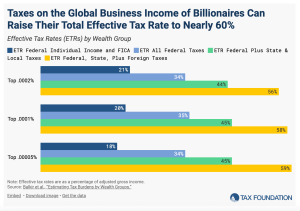
Actually, they pay more than their fair share (link). “At the federal level, the top 10 percent of income earners pay more than 60 percent of all taxes and 72 percent of income taxes, shares that have been increasing over time (resource).”
More importantly: billionaires create value.
Amazon is valuable. An online marketplace that sells just about everything, delivers it to you quickly, and accepts returns without complaint? It’s borderline miraculous. It’s secure, reliable, and efficient. All the things Bezos said it would have to be to convince people to give their credit card number to a website back in 2000.
Billionaires invest in other businesses, helping to build enterprises that employ people. Far from the idle piles of gold coins amassed by Scrooge McDuck, modern-day billionaires are invested in everything from AI to space travel. They are funding research into renewable energy and curing chronic insidious diseases.
There’s nothing wrong with creating value. An entrepreneurial society, a free market society, wants value creation. We want companies innovating and competing with one another to earn our business. Value creation is why Whataburger, McDonald’s, and Chick-fil-A occupy three of the four corners off the Killian Road exit on I-77. Choices mean competition for customers. Competition lowers prices and improves product quality for everyone.
And the people who took the risk to build those things, the people who had the idea, invested their time, energy, and money into building it; the people who sacrificed family and privacy, to build and grow enterprises, they are worthy of compensation.
Countries that seize entrepreneurial enterprises, that allocate to the state that which belongs to the innovator, countries that steal intellectual property, overtax industry, or abuse innovators will lose those innovators. Just ask the Soviet Union. State-controlled enterprises do not innovate, they have no competition and no reason to improve.
Markets thrive on competition, new entrants to industry, innovation in product design, operations, and distribution. Markets offer us choices, competition forces companies to evolve and respond to consumer preferences. Those strategic choices and the leadership that makes them will generate and accumulate wealth.
Wealth is not a finite commodity. There is endless opportunity in markets when innovation is allowed to flourish. These are infinite games, as Simon Sinek would say, wherein there are no boundaries or set players. Anyone can participate. Create value and prosperity will follow.
So let the billionaires get paid what they’re worth. And be wary of any state or politician that tries to tell you what that worth is. Markets determine worth, not government. If you didn’t think Amazon was valuable, you’d stop buying from it.
The tax code is the problem.
Despite knowing that wealthy individuals pay a disproportionate amount in taxes (70% of all income tax revenue), the “tax the rich” crowd inevitably claims loopholes, deductions, and exceptions are written into the tax code to benefit the rich.
If our tax code was built to generate revenue, we could easily place it opposite our expenses and balance our budget. But our tax code is the marionette strings used by politicians to get people to do what they want them to do.
Have a kid. Buy a house. Save for college. Put your business in distressed neighborhoods. Upgrade your home with green technology. Pay your parents’ medical bills.
The tax code is overwrought with programs designed to get citizens and businesses to do what the politicians want them to do. It’s both carrot and stick. It’s a political tool to “enact policy” and “promote the general welfare.”
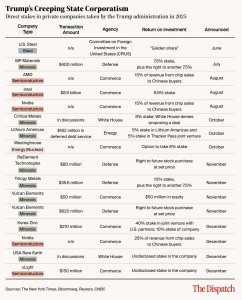
It’s also how the government picks winners and losers. Certain industries (green energy) thrive under certain regimes (the Biden administration) and others (rare earth minerals, fossil fuels) thrive under the next regime (Trump 2.0). Add to that Treasury Secretary Bessant’s recent “investments” of taxpayer money into strategic industries (favorite companies) and you have the ultimate political puppet show.
The seesaw of economic policy with the tax code as the primary fulcrum is worse than uncertainty. It’s blatant market manipulation.
Government distorts markets.
When our government infuses industries with cash, it distorts the market. That’s how student loans got wildly out of control. It’s how medicare has ruined healthcare. When the policy makers decide to interfere, they add regulations or remove them, they fund initiatives or defund them, and they claim credit for growth in every metric from job creation to gas prices.
But it’s not governance. It’s interference. And it’s become big business. Companies seeking to influence policy and ease their own path to prosperity have become huge donors to campaigns and parties. It’s a corporate strategy to influence government policy. To raise the barriers to entry in some markets like healthcare and travel, and to secure revenue streams in services like data collection, usage, and sales. Companies pay political influence for regulations and legislation. That’s half the problem.
The government buys too much from too many providers.
Government procurement is the other half of the problem. It is complicated and corrupt. The government does not own the means of production for anything it wants to do (which is a good thing) and so it hires government contractors. Companies that understand how to write requests for proposals (RFPs) and to respond to those RFPs. Companies that know the ins and outs of provider status like disabled-veteran-owned, female-owned, minority-owned and use intricate networks of primary contract holders to sub-con their way to lucrative government work.
There is an insidious industry feeding on federal, state, and local procurement. Everyone knows it’s there. And no one does anything about it.
From Boeing to Palantir and all the small, medium, and large businesses in between recognize what the politicians want to do and offer their services to do it. Government is just another customer for these companies. In some cases, it’s the only customer. And that means the companies pursue and protect those government relationships. The entire alphabet soup of agencies has contractors. It’s why reducing the federal workforce (as DOGE tried to do) doesn’t actually reduce the size of the government.
How do we fix the monstrosity that is federal government waste and corruption? How do we slay the vampires infesting the capitol?
We have to ask government to do less. Not more.
We have to turn off the valves of government spending. Stop the flow of taxpayer money to contractors who overcharge and under deliver. Stop funding programs and initiatives that, were they truly valuable, could find private sector funding for the work they’re doing. Stop letting politicians claim to fix problems when, really, they’re just hiring some overpriced contractor to act like it’s fixed.
Bringing federal money to South Carolina to pay for things is not valuable work.
It’s milking taxpayers and skimming the cream off the top of the bucket. In some cases, it’s taking big ladles and pouring the milk over special interests and corporate donors.
We have to stop electing politicians funded by parties that turn corporate donations into government favors like some kind of demented Rumplestiltskin.
This job should be about governing. Not spending. It should be about oversight. Not access.
The answer is not to tax the billionaires more aggressively. The answer is to 1) spend less, and 2) stop letting those billionaires get rich off duopoly corruption.
It’s a self-licking ice cream cone, the federal government. Existing to provide wealth redistribution. From taxpayers to corporate contractors, the government is looting the people and enriching the parties.
What can you do?
Start with this election. Start by choosing the most underfunded, least-connected candidate in every race. Get the fresh blood, uncontaminated by the party machinery, into office. Let those willing citizens steer the ship. They won’t all be star players. But they’re willing to come off the bench.
Find the full list of candidates in South Carolina here.
We heard Trump say he would drain the swamp. In South Carolina, it’s time to clean house. Find the candidates who tell the truth. The ones who will do the right thing. Find the good people willing to get in the game.
This is dumb. How are you going to represent a body of people who are not billionaires with this attitude?
Thanks for reading, David. I plan to reduce government spending and hold people accountable for taking taxpayers for a ride. I think that will be pretty good work, representative of folks that are sick of being looted. Cheers! -KW
Good answer. The socialists are always looking for someone to target and steel from. They selfishly want other peoples earnings to fund what they want. Almost everyone is being skinned to provide a source of funding for the outrageous spending. Many people, hurting, are trying to point to some other source of government taking instead of focusing on the real problem of overspending.
Thanks for reading! I look forward to working on the “spend less” strategy of addressing the national debt.