So far, my favorite thing about campaigning has been answering questions about being a libertarian. I get to talk about how government should mind its own business and stay out of ours. I get to say, “let people prosper: entrepreneurs, families, schools, communities.” Get government out of the way and we will cooperate.
We don’t need to be coerced to care for one another.
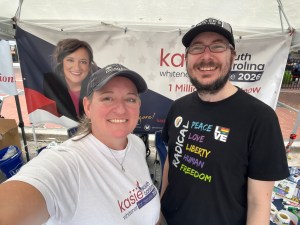
And it’s the caring for one another that has people nodding along. Especially at places like Okra Strut, a community-organized showcase of businesses and organizations in Irmo. And at SC Pride, a celebration of families on Main Street in Columbia. When we are in-real-life (IRL) together, face-to-face and shaking hands, we can feel how much we care for one another.
In a recent episode of the Mel Robbins podcast, researcher Dr. Todd Rose revealed that people are remarkably similar in our values and ambitions for our own lives. The data on what people actually care about and value is startling (this clip): in the top 10 aspirations for the country, we agreed on 8 of the 10.
“There’s a basic kind of life we want to live together and we know that we owe each other certain things to make that life possible.” How incredibly powerful is that? He listed among those things: individual rights, free speech, treating each other with respect, everyone having high-quality healthcare.
“We might disagree on how we do it,” he continued, “but it turns out the ultimate aims were shockingly similar.”
So why all the fighting? Dr. Rose says we believe a collective illusion that ‘the other side’ thinks differently than us and that they are trying to destroy us. In actuality, we all want the same things and, in our estimation of success, we agree that a successful life has a common definition.
“The number one priority for a successful life is, ‘I want to do work that has a positive impact on others.” Relationships, family, character, self-improvement, and growth dominated; including “I want to be more engaged in my community.”
And yet, we don’t know how to be engaged; many respondents judged themselves as not doing enough in their community. We have lost the social layer of society that keeps us connected and serving one another.
Where did it go? It was consumed by government. Councils, agencies, task forces, programs, state-run, state-funded evidence the politicians are solving our problems. Except they aren’t.
Poverty rates have stayed pretty much the same since the war on poverty was declared in the 1960s. Drug use, abuse, and addiction rates remained steady for decades before climbing during the COVID-19 pandemic. This, despite $1 trillion dollars spent on the War on Drugs launched in 1971. The U.S. government loses between $230 and $530 billion every year to fraud. That’s resources not making our lives better, just being mismanaged.
For too long we have trusted government to do what we, as citizens, can be trusted to do. If you don’t think that’s true, ask who feeds the unhoused people in your community? Who brings them coats and blankets in the winter? Who ministers to addicts, runs addiction services, and gives jobs and second chances to those in recovery? Churches, communities, and businesses do those things. Without siphoning off tax dollars from coerced citizens.
We can be trusted to care for one another.

There’s no evidence that people will turn their backs on their neighbors and friends. In fact, the evidence says we are the most generous people on earth. After taxes, Americans gave $392.45 billion in 2024, as individual donors.
Why don’t we trust one another? Why don’t we ask one another for help? Why do we expect government to fill in where we should be showing up?
We’re working. The forty-hour work week robs us from our communities and families. As a national standard, it means we dedicate more time to our employer than our family, our neighborhood, and our faith community combined.
We’re raising our kids. They’re scheduled to within an inch of their lives. Baseball and soccer and tutoring and ballet and Lord have mercy! They’re college-bound in elementary school.
We’re being lied to. Politicians and government agencies tell us they will take the burden of community care from us, they will solve our collective problems. It’s how they get elected. It’s how they raise taxes. They promise to do more. And then they just don’t.
When we give back, we feel great about ourselves and our communities. So why don’t we do more of it? It’s over complicated by government. To organize an event you’ll need city or county permits, a business license, and insurance. Social media makes it easier than ever to connect groups of people around good causes and there are more digital access platforms than ever – Go Fund Me, Donorbox, etc. But even those sites issue IRS documentation in case the funds given are taxable (again).
Government is everywhere. It’s intrusive, invasive, and often an impediment to cooperative community action. Libertarians believe we don’t need to be coerced to care for one another. In every problem, I will ask, “Can we do this with less government?”
In the US Senate, as part of the role of oversight, I will hold government agencies accountable for specific, measurable outcomes. Where they are unable to demonstrate competence, or where they are obstructing the work of citizens and communities, I will defund them.
Ready to get in the game? We could use your help. Click here to sign up.